Trouble falling asleep, staying asleep, or waking up unrefreshed is one of the most common health complaints there is, and it has a real connection to testosterone. Most of a man’s daily testosterone is released during sleep, so when sleep breaks down, hormone levels follow. But the relationship runs in both directions, and understanding that loop is the key to fixing it.
The evidence is striking. In a controlled study, just one week of sleeping five hours a night lowered daytime testosterone in healthy young men by 10 to 15 percent, a drop comparable to aging more than a decade. Poor sleep is not a minor inconvenience to your hormones, it is one of the fastest ways to lower them.
This post breaks down how sleep and testosterone feed each other, where sleep apnea and cortisol fit in, why chasing the hormone can backfire, and which labs are worth running. If your sleep has been poor and you want to understand what is really going on, this is for you.
The Four Forces Behind Poor Sleep
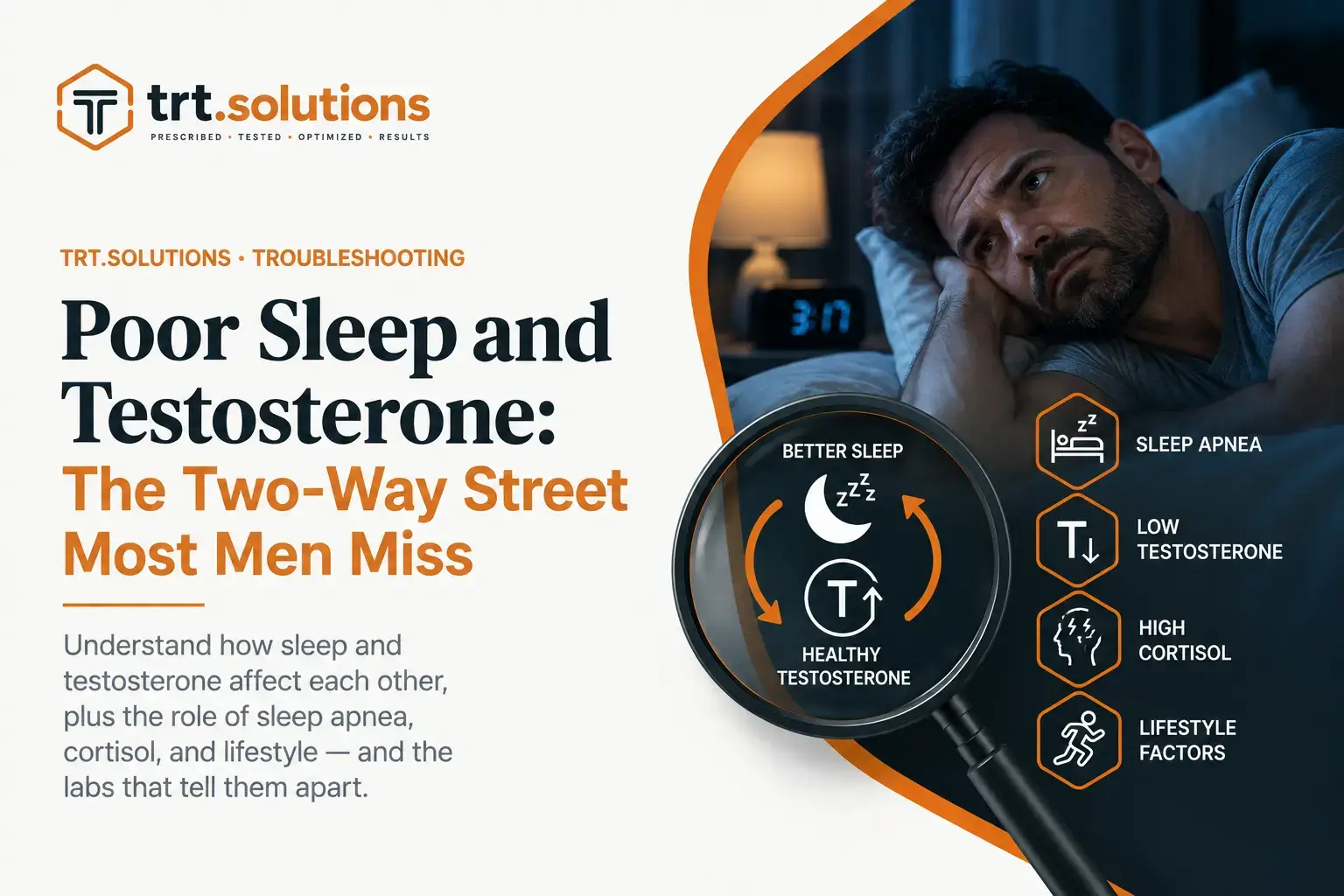
The card that brought you here lists four causes, and they are tightly linked. Sleep sits at the center of a hormonal loop, which is why poor sleep is rarely just one problem.
- Sleep apnea. The most important cause to rule out. Obstructive sleep apnea fragments sleep and starves the body of oxygen overnight, and it independently lowers testosterone, so it is both a sleep problem and a hormone problem.
- Low testosterone. Because most testosterone is released during sleep, low levels and poor sleep feed each other. Men with low testosterone frequently report insomnia and restless, broken nights.
- High cortisol. The stress hormone is meant to fall at night. When chronic stress or sleep loss keeps cortisol elevated, it promotes alertness at the wrong time and suppresses testosterone at the same time.
- Lifestyle. Screens late at night, alcohol, caffeine, irregular schedules, and shift work all disrupt the circadian rhythm that governs both sleep and hormone release, often more than men realize.
The takeaway is that poor sleep is usually a loop rather than a single fault. That is why it can feel self-perpetuating, and also why the right change can improve several things at once.
The Vicious Cycle: How Sleep and Testosterone Feed Each Other
This is the central idea of the whole topic. The majority of a man’s daily testosterone is produced during sleep, particularly during the deeper stages, so anything that shortens or fragments sleep cuts into that production. That is exactly what the one-week sleep-restriction study demonstrated, a measurable drop in testosterone from too little sleep alone.
The loop closes because low testosterone then disturbs sleep in return, contributing to insomnia and lighter, more broken nights. Add cortisol, which rises with sleep loss and further suppresses testosterone, and you have a self-reinforcing cycle. This is the same disrupted sleep that sits underneath fatigue and low energy and brain fog, which is why sleep is so often the thread connecting several symptoms at once.
Sleep Apnea: The Cause You Must Not Miss
Of the four causes, sleep apnea is the one that most needs ruling out, because it does real harm beyond fatigue and it is so often undiagnosed. In obstructive sleep apnea, the airway repeatedly collapses during sleep, fragmenting rest and causing drops in blood oxygen that stress the heart and the hormonal system alike.
The hormonal impact is direct. The intermittent hypoxia and fragmentation of apnea raise cortisol and suppress the signaling that drives testosterone production, and men with apnea consistently show lower testosterone than those without it. There is also a two-way twist worth knowing, low testosterone may worsen airway muscle tone, and importantly, high-dose testosterone therapy can itself aggravate sleep apnea. That is a key reason not to treat suspected low testosterone before apnea has been assessed.
The Role of Cortisol and Lifestyle
The remaining two causes are the ones most within your direct control, and they often matter more than any supplement or hormone.
- Cortisol and stress. Cortisol should decline in the evening to let you sleep. Chronic stress keeps it elevated, which fragments sleep and suppresses testosterone, so managing stress is part of managing sleep.
- Light and screens. Bright and blue light late at night suppresses melatonin and delays the body clock, making it harder to fall asleep at the right time.
- Alcohol and caffeine. Alcohol fragments the second half of the night and worsens apnea, while late caffeine delays sleep onset. Both quietly degrade sleep quality even when total hours look fine.
- Schedule and consistency. Irregular bed and wake times and shift work disrupt the circadian rhythm that governs both sleep and the overnight testosterone release.
The Labs and Assessments That Settle It
The point of testing is to find where you are in the loop and to catch sleep apnea, which needs a sleep study rather than a blood test. Hormones are measured carefully, because timing changes the result.
- A sleep study. The single most important assessment here. If you snore, wake unrefreshed, gasp, or a partner notices pauses in breathing, a sleep study is how apnea is confirmed, and it should generally come before any hormone treatment.
- Morning total and free testosterone, repeated. Drawn in the morning and confirmed on a second occasion. Poor sleep can temporarily lower the reading, so results are interpreted in the context of your sleep.
- Cortisol, when stress is prominent. Can help clarify the picture when chronic stress or an abnormal daily rhythm is suspected, though it is interpreted carefully because cortisol naturally varies through the day.
- Thyroid (TSH). Thyroid problems can disturb sleep and energy, so a simple screen helps rule them in or out.
- A lifestyle and sleep-habit review. Not a lab, but essential. An honest look at screens, alcohol, caffeine, and schedule often explains more than any single test.
Reference ranges vary between laboratories, so read each result against your own report, and interpret the whole picture rather than fixating on one number.
Why Testosterone Alone Rarely Fixes Sleep
Even when testosterone is genuinely low, treating it will not fix sleep that is being wrecked by apnea, stress, or poor habits, and in the case of untreated apnea, testosterone therapy can actually make the breathing problem worse. Because the cycle runs both ways, improving sleep often raises testosterone on its own, without a prescription.
That is the shift this approach is built around. Poor sleep is a signal to look at the whole loop, apnea, stress, lifestyle, and hormones, and to fix the part that is actually breaking the cycle, which for many men is the sleep itself rather than the hormone.
What to Do Right Now
- Screen for sleep apnea first. If you snore, wake unrefreshed, or a partner notices pauses in breathing, ask about a sleep study before anything else, since apnea changes everything about how low testosterone should be handled.
- Protect your sleep basics. Keep a consistent schedule, cut late screens, alcohol, and caffeine, and give yourself enough time in bed. These directly support the overnight testosterone release.
- Address stress deliberately. Because cortisol and testosterone pull against each other, managing stress is part of fixing both sleep and hormones, not a separate issue.
- Ask for the right workup. Request morning total and free testosterone plus TSH, and raise sleep apnea explicitly so a sleep study is considered alongside the bloodwork.
- Do not start testosterone to fix sleep. Testosterone is not a sleep treatment, and it can worsen untreated apnea. Let the sleep assessment and your prescriber guide the order of treatment.
Frequently Asked Questions
Q: Does poor sleep really lower testosterone?
Yes, and quickly. In a controlled study, one week of five-hour nights lowered daytime testosterone in healthy young men by 10 to 15 percent. Because most testosterone is released during sleep, cutting sleep short directly reduces it.
Q: Does low testosterone cause insomnia, or does insomnia cause low testosterone?
Both, which is the key point. The relationship is bidirectional. Poor sleep lowers testosterone, and low testosterone disturbs sleep, creating a self-reinforcing loop that is best addressed from both ends.
Q: Why is sleep apnea so important to check?
Because it harms far more than your energy. Apnea fragments sleep, drops your oxygen, raises cortisol, and lowers testosterone, and it is often undiagnosed. Crucially, high-dose testosterone therapy can worsen apnea, so it should be assessed before starting treatment.
Q: Can improving my sleep raise my testosterone without medication?
Often, yes. Because the cycle runs both ways, restoring good, sufficient sleep supports the overnight testosterone release and can improve levels naturally, which is why sleep is usually the first thing to fix.
Q: How does stress affect my sleep and hormones?
Chronic stress keeps cortisol elevated when it should be falling at night, which fragments sleep and suppresses testosterone at the same time. Managing stress is therefore part of managing both sleep quality and hormone levels.
Related Reading
- Fatigue and Low Energy: When It’s Testosterone, and When It’s Something Else the symptom most tightly linked to poor sleep and apnea.
- Brain Fog and Poor Concentration another symptom driven heavily by disrupted sleep.
- TRT Symptoms the full list of symptoms worth checking.
- Ask Your Prescriber how to turn your labs into the right questions.
References
- Leproult R, Van Cauter E. (2011). Effect of 1 Week of Sleep Restriction on Testosterone Levels in Young Healthy Men. JAMA. https://jamanetwork.com/journals/jama/fullarticle/1029127
- Sleep loss lowers testosterone in healthy young men. UChicago Medicine. https://www.uchicagomedicine.org/forefront/news/sleep-loss-lowers-testosterone-in-healthy-young-men
- Wittert G. Sleep, testosterone and cortisol balance, and ageing men. Reviews in Endocrine and Metabolic Disorders (PMC). https://www.ncbi.nlm.nih.gov/pmc/articles/PMC9510302/
- Sleep apnea, heart health and testosterone: unravelling the triad of well-being. PMC. https://pmc.ncbi.nlm.nih.gov/articles/PMC12988546/
- Obstructive Sleep Apnea Is Associated With Low Testosterone Levels in Severely Obese Men. PMC. https://www.ncbi.nlm.nih.gov/pmc/articles/PMC8350060/
- Imbalance in the diurnal salivary testosterone/cortisol ratio in men with severe obstructive sleep apnea. PMC. https://www.ncbi.nlm.nih.gov/pmc/articles/PMC9444622/
- Impact of Five Nights of Sleep Restriction on Glucose Metabolism, Leptin and Testosterone in Young Adult Men. PMC. https://www.ncbi.nlm.nih.gov/pmc/articles/PMC3402517/
- American Urological Association. Testosterone Deficiency Guideline. https://www.auanet.org/guidelines-and-quality/guidelines/testosterone-deficiency-guideline
Disclaimer
This article is for informational and educational purposes only. It does not constitute medical advice, and reading it does not create a patient-provider relationship. Individual symptoms and treatment needs vary, so please consult a qualified healthcare professional for personalized guidance, and never start, stop, or change any medication or therapy without your prescriber.