
Persistent tiredness that doesn’t lift no matter how much you sleep is one of the most common reasons men start wondering about their testosterone. It’s an intuitive leap, since low T does cause fatigue and the connection is real. But it’s also where a lot of people go wrong, because fatigue is one of the least specific symptoms in medicine.
Major clinical guidelines are blunt about this. The American Urological Association notes that the symptoms blamed on low testosterone are very non-specific and can just as easily come from chronic stress, poor sleep, or depression. That’s exactly why no responsible clinician diagnoses low T from how you feel alone. It takes bloodwork, done properly, to tell the causes apart.
This post breaks down what actually drives unexplained fatigue in men, how testosterone fits into the picture, which labs settle the question, and what to bring to your prescriber. If you’ve been exhausted and are trying to figure out whether your hormones are really the problem, this is for you.
Why Fatigue Points in So Many Directions
Fatigue is a final common pathway. Dozens of different problems all produce the same worn-out feeling. Testosterone is one input, but it sits alongside several others that are, in many men, more likely explanations.
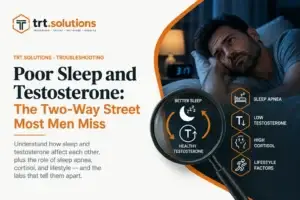
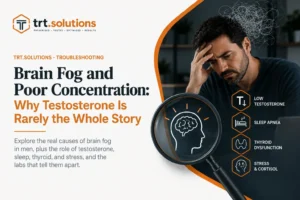
The card that brought you here lists the usual suspects for a reason. Each one can produce identical tiredness, and more than one can be true at the same time.
- Low testosterone. A genuine cause. Fatigue, reduced strength, low motivation, and low mood are recognized features of testosterone deficiency. But it has to be confirmed, not assumed.
- Sleep apnea. Fragmented, oxygen-starved sleep causes profound daytime fatigue and independently lowers testosterone, so it can look exactly like low T while also causing it.
- Thyroid dysfunction. An underactive thyroid slows the whole body down, producing tiredness, cold intolerance, and low mood. It’s more common than low T and frequently missed.
- Iron deficiency. Low iron stores drain energy even before anemia shows up on a standard blood count, and it’s easy to overlook in men because it’s stereotyped as a women’s issue.
The practical takeaway is simple. Treating the first plausible cause, usually testosterone because it’s the one everyone has heard of, without checking the others is how men end up on therapy that doesn’t fix the tiredness.
What Low Testosterone Fatigue Actually Feels Like
Testosterone deficiency rarely shows up as fatigue alone. Position statements from endocrine bodies describe a cluster, where the tiredness travels with other changes, and it’s the pattern rather than any single symptom that raises suspicion.
- Reduced physical strength and endurance. Workouts feel harder and recovery takes longer, beyond what training load explains.
- Loss of motivation and concentration. A flatness or difficulty focusing that reads as low drive rather than sleepiness.
- Lower libido and sexual changes. Reduced desire and fewer spontaneous erections often accompany genuine deficiency.
- Irritability and low mood. Mood shifts that track with the other symptoms rather than a clear life stressor.
If your fatigue comes as a lone symptom with none of this cluster, low testosterone becomes a less likely single explanation, which is one more reason the labs matter.
The Sleep Apnea Trap
Sleep apnea deserves its own section because it’s the cause most likely to masquerade as low T. Testosterone is produced largely during deep sleep, so when apnea repeatedly fragments your nights, your levels fall. Research has found that men with severe obstructive sleep apnea can have markedly lower total and free testosterone than men without it.
This creates a genuine trap. Test a man with untreated apnea and you may find low testosterone. Treat the testosterone and you’ve missed the actual driver, the disordered breathing that’s wrecking his sleep, straining his heart, and lowering his hormones all at once. Snoring, waking unrefreshed, morning headaches, or a partner noticing pauses in breathing all belong on the list regardless of the hormone numbers.
The Labs That Settle It
The point of testing is to separate these causes, not to confirm the one you already suspect. Guidelines are specific about how testosterone in particular must be measured, because sloppy sampling produces false results.
- Morning, fasting total testosterone, repeated. Testosterone peaks in the early morning, so a proper measurement is drawn early in the day and confirmed on a second occasion. Afternoon or one-off draws are a common source of false low readings.
- Free testosterone, when indicated. Total T tells you the size of the pool; free T tells you how much is actually available to tissue. The two can diverge, which is why guidelines call for accurate assays and proper reference ranges.
- LH and FSH. These pituitary hormones help locate where a real deficiency originates, and separate a testicular cause from a signaling one.
- TSH for the thyroid. A simple screen for the underactive thyroid that mimics, and can coexist with, low T.
- Ferritin and a full blood count. Ferritin catches depleted iron stores before anemia appears; the blood count flags anemia itself.
- A sleep assessment. If apnea symptoms are present, a sleep study belongs alongside the bloodwork, since it can be both the cause of fatigue and a reason to be cautious about starting testosterone.
Reference ranges vary between laboratories, so read every result against the range printed on your own report, and interpret the whole panel together rather than fixating on a single number.
Why Testosterone Alone Often Isn’t the Answer
Even when testosterone comes back genuinely low, guidelines don’t treat that as an automatic prescription. The Endocrine Society recommends diagnosing deficiency only when low levels are paired with consistent symptoms, and evaluating the underlying cause before starting therapy, rather than simply topping up a number.
That’s the shift this whole approach is built around. Fatigue is a signal to investigate broadly, confirm carefully, and treat the actual driver, which sometimes is testosterone and often is something that testosterone won’t fix.
What to Do Right Now
- Notice the pattern, not just the tiredness. Jot down whether your fatigue travels with low libido, low mood, strength loss, snoring, or feeling cold. The cluster tells a clinician more than the fatigue alone.
- Ask for the full panel, not just testosterone. Request morning total and free T, LH, TSH, ferritin, and a blood count together, so one draw rules several causes in or out.
- Get the draw timing right. Insist on an early-morning, fasting testosterone sample, and expect it to be repeated before anyone concludes anything.
- Take sleep seriously. If you snore, wake unrefreshed, or your partner notices pauses in breathing, ask specifically about a sleep study.
- Don’t self-diagnose from symptoms. Fatigue is too non-specific to act on alone. Let the labs and your prescriber decide what’s actually going on before starting any therapy.
Frequently Asked Questions
Q: Does low testosterone always cause fatigue?
No. Fatigue is one recognized symptom of testosterone deficiency, but many men with low readings have other causes of their tiredness, and many fatigued men have normal testosterone. The symptom on its own doesn’t confirm the diagnosis.
Q: Can I just get my testosterone tested and skip the rest?
You can test it, but testing it in isolation often misleads. Because sleep apnea, thyroid problems, and iron deficiency all cause the same fatigue, and some of them lower testosterone themselves, checking them together gives a far clearer answer.
Q: Why does the timing of the blood test matter so much?
Testosterone follows a daily rhythm and peaks in the early morning. A sample drawn in the afternoon, or after a poor night or illness, can read falsely low, which is why guidelines call for a morning, fasting draw confirmed on a second occasion.
Q: Could my tiredness be sleep apnea even if I don’t feel like I stop breathing?
Yes. Many people with sleep apnea aren’t aware of it. The clues are loud snoring, waking unrefreshed, morning headaches, or a partner noticing pauses. A sleep study is the way to know, and it matters because apnea both causes fatigue and lowers testosterone.
Q: If my testosterone is low, will therapy fix the fatigue?
Sometimes, when low testosterone is genuinely the driver. But if the real cause is untreated apnea, thyroid dysfunction, or iron deficiency, testosterone therapy may not resolve the tiredness, which is why guidelines stress confirming the diagnosis and cause first.
References
- American Urological Association. Testosterone Deficiency Guideline. https://www.auanet.org/guidelines-and-quality/guidelines/testosterone-deficiency-guideline
- Endocrine Society. Testosterone Therapy for Hypogonadism, Clinical Practice Guideline. https://www.endocrine.org/clinical-practice-guidelines/testosterone-therapy
- Society for Endocrinology. (2018). Position Statement on Male Hypogonadism and Ageing. https://www.endocrinology.org/media/2710/male-hypogonadism-and-ageing-2018.pdf
- Cleveland Clinic. Low Testosterone (Male Hypogonadism): Symptoms, Causes, Diagnosis and Treatment. https://my.clevelandclinic.org/health/diseases/15603-low-testosterone-male-hypogonadism
- Surampudi PN, Wang C, Swerdloff R. (2012). Hypogonadism in the Aging Male: Diagnosis, Potential Benefits, and Risks of Testosterone Replacement Therapy. PMC. https://www.ncbi.nlm.nih.gov/pmc/articles/PMC3312212/
- Male Hypogonadism. StatPearls, NCBI Bookshelf (NIH). https://www.ncbi.nlm.nih.gov/books/NBK532933/
- Obstructive Sleep Apnea Is Associated With Low Testosterone Levels in Severely Obese Men. PMC. https://www.ncbi.nlm.nih.gov/pmc/articles/PMC8350060/
- A Practical Guide to Male Hypogonadism in the Primary Care Setting. PMC. https://www.ncbi.nlm.nih.gov/pmc/articles/PMC2948422/
Disclaimer
This article is for informational and educational purposes only. It does not constitute medical advice, and reading it does not create a patient-provider relationship. Individual symptoms and treatment needs vary, so please consult a qualified healthcare professional for personalized guidance, and never start, stop, or change any therapy without your prescriber.