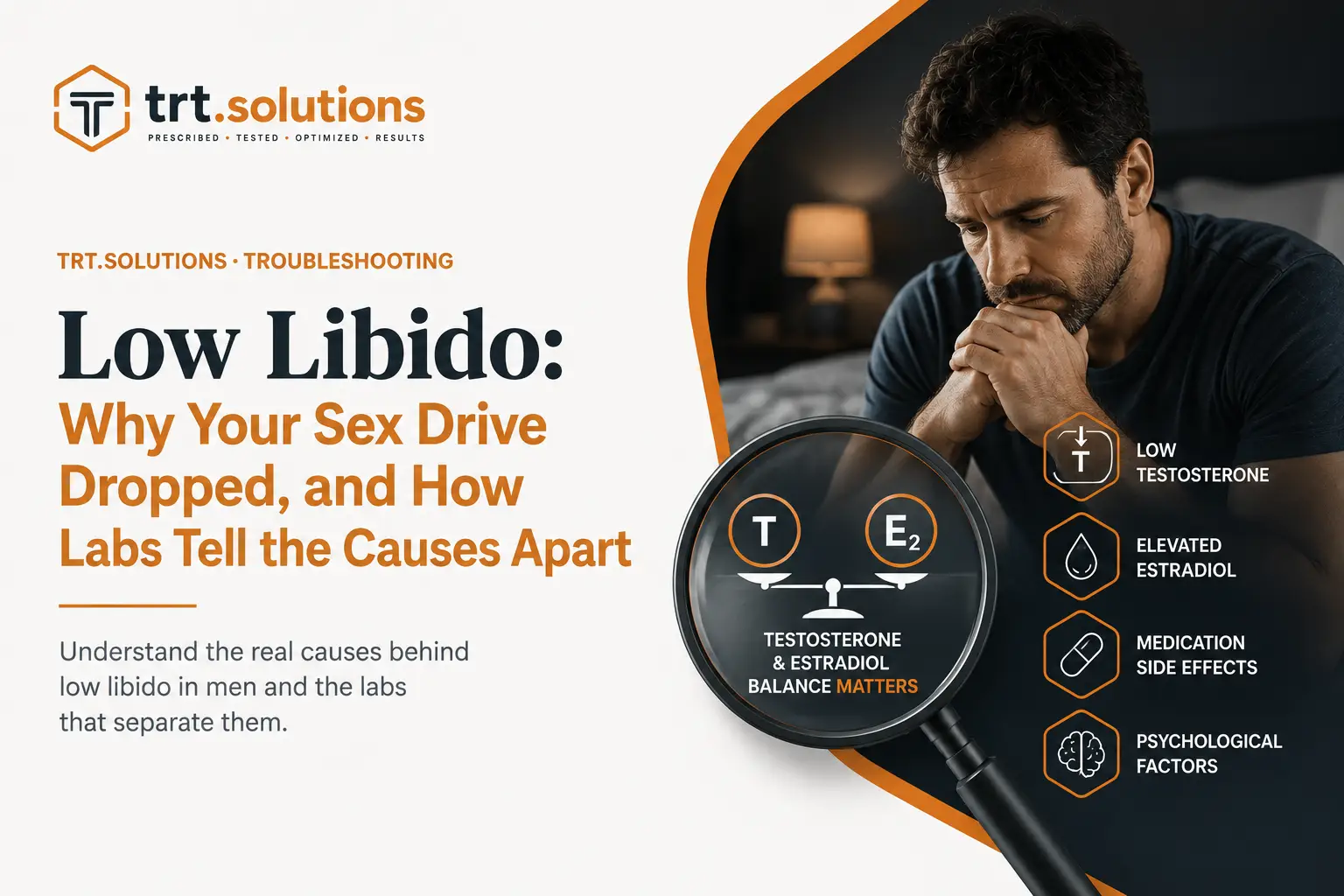
A drop in sex drive is one of the most common and most distressing things men bring to a clinician, and also one of the most misread. The instinct is to assume it must be testosterone. Sometimes it is. But low libido sits at the intersection of hormones, medications, and the mind, and telling those apart is exactly what a proper workup is for.
The Merck Manual puts the range of causes plainly: reduced sex drive in men commonly comes from psychological factors such as depression, anxiety, or relationship strain, from medications, and from low testosterone. Those are very different problems with very different fixes, and you cannot tell which one you have from the feeling alone.
This post breaks down what actually lowers libido, why estradiol matters as much as testosterone, how common medications quietly blunt desire, and which labs settle the question. If your interest in sex has faded and you want to understand why, this is for you.
The Four Directions Low Libido Comes From
The card that brought you here lists four causes for a reason. Each can flatten desire on its own, and in real life they often overlap, which is why a single explanation is usually too simple.
- Low testosterone. The best-known hormonal cause. Reduced desire is one of the most consistent symptoms of genuine testosterone deficiency, but it has to be confirmed with properly timed labs, not assumed. The same low-T picture drives other complaints too, which is why it overlaps with fatigue and low energy.
- Elevated estradiol. Testosterone converts to estradiol, and the balance between them matters. Too much estradiol relative to testosterone can blunt libido even when total testosterone looks adequate.
- Medication. A large number of everyday drugs lower desire as a side effect, especially antidepressants and hair-loss medication. This cause is common and frequently missed because nobody connects the pill to the symptom.
- Psychological factors. Depression, anxiety, stress, and relationship difficulty are among the most common drivers of all, and they can both cause low libido and result from it.
The takeaway is that libido is a poor lie detector for any single cause. It tells you something is off, not what. That is the whole reason to investigate rather than guess.
The Testosterone and Estradiol Balance
Testosterone gets all the attention, but estradiol, the main estrogen, is essential for male sexual desire too. Research describes estradiol as necessary for modulating libido, erectile function, and arousal in men, working alongside testosterone rather than against it.
That is why the ratio between the two can matter more than either number alone. Some clinicians look at the testosterone to estradiol relationship, and men with both low testosterone and high estradiol tend to report the most trouble. Excess estradiol is often driven by higher body fat, since fat tissue converts testosterone to estrogen, so the fix is not always hormonal in the way people expect.
The Medications That Quietly Lower Desire
This is the cause most worth ruling out early, because it is common, reversible, and easy to overlook. If your libido dropped after starting a new medication, the timing itself is a clue.
- Antidepressants (SSRIs and SNRIs). Sexual side effects including reduced libido are among the most common complaints with these drugs, with realistic estimates of sexual dysfunction often in the range of a third to half of users.
- Finasteride and hair-loss drugs. 5-alpha-reductase inhibitors used for hair loss and prostate symptoms are associated with reduced libido and other sexual side effects in some men, occasionally persisting after stopping.
- Other agents. Drugs that lower testosterone, opioids, some blood-pressure medications, and heavy alcohol use can all reduce desire. Alcohol in particular lowers testosterone and worsens sexual function over time.
One firm rule: never stop a prescribed medication on your own to test this theory. Bring the timing to your prescriber, who can weigh a switch, a dose change, or an alternative safely.
The Psychological Side Is Not a Lesser Cause
It is tempting to treat psychological causes as the leftover category once hormones are ruled out, but that gets it backwards. Depression, anxiety, chronic stress, and relationship conflict are among the most frequent reasons desire fades, and they deserve the same seriousness as a lab value.
There is also a two-way street. Low libido strains relationships and self-image, which deepens the anxiety and low mood that suppress desire further. Breaking that loop sometimes matters more than any hormone number, and depression itself independently reduces libido separate from any medication used to treat it.
The Labs That Settle It
The point of testing is to separate hormonal causes from the rest, and to catch the estradiol imbalance that a testosterone-only panel would miss. Guidelines are specific about how these are measured.
- Morning total and free testosterone, repeated. Testosterone peaks early in the day, so it is drawn in the morning and confirmed on a second occasion. Free testosterone shows how much is actually available to tissue.
- Estradiol. Measured alongside testosterone so the balance between them can be judged, not just the testosterone number in isolation.
- SHBG. Sex hormone-binding globulin controls how much testosterone is free versus bound, so a high level can leave you symptomatic even when total testosterone looks normal.
- LH and FSH. These pituitary hormones help locate where a real deficiency originates if the testosterone comes back low.
- Prolactin. An elevated level can suppress libido and points to a specific, treatable cause that would otherwise be missed.
- A medication and mood review. Not a blood test, but part of the workup. Listing every drug you take and screening for depression or anxiety is as important as the hormones.
Reference ranges vary between laboratories, so read each result against your own report, and interpret the panel as a whole rather than fixating on one number. When you have your results, our guide on how to talk it through with your prescriber can help you turn the numbers into the right questions.
What to Do Right Now
- Map the timeline. Note when your libido changed and what else changed around then, a new medication, a stressful period, weight gain, or a relationship shift. The timing often points straight at the cause.
- List every medication and supplement. Bring a complete list to your appointment, including antidepressants and hair-loss drugs, so a medication cause can be considered rather than overlooked.
- Ask for the full hormone panel. Request morning total and free testosterone, estradiol, SHBG, LH, FSH, and prolactin together, so the testosterone to estradiol balance is visible, not just testosterone alone.
- Be honest about mood and stress. Depression, anxiety, and relationship strain are leading causes, so mention them plainly. They are treatable and not a smaller problem than hormones.
- Do not self-treat. Do not stop a medication or start testosterone or an estrogen blocker on your own. Let the labs and your prescriber decide what the actual driver is first.
Frequently Asked Questions
Q: Does low libido always mean low testosterone?
No. Low testosterone is one cause, but medications, elevated estradiol, and psychological factors like depression and stress are at least as common. Many men with low desire have normal testosterone, which is why testing the full picture matters.
Q: Can high estradiol lower my sex drive even if my testosterone is fine?
Yes. Estradiol is necessary for male libido, but too much relative to testosterone can blunt desire, and this is often driven by higher body fat. That is why estradiol should be measured alongside testosterone rather than ignored.
Q: My libido dropped after starting an antidepressant. Is that connected?
It may well be. Reduced libido is one of the most common side effects of SSRIs and SNRIs. Do not stop the medication on your own, but raise the timing with your prescriber, who can consider a switch or an adjustment.
Q: Can hair-loss medication affect libido?
In some men, yes. Finasteride and related drugs are associated with reduced libido and other sexual side effects, which occasionally persist after stopping. If your desire changed after starting one, discuss it with your prescriber.
Q: What if my labs are all normal?
Then the cause is more likely psychological or relational, or tied to a medication or lifestyle factor rather than a hormone. Normal labs are useful information, not a dead end, and they point the workup toward mood, stress, and relationship factors that are genuinely treatable.
Related Reading
- Fatigue and Low Energy: When It’s Testosterone, and When It’s Something Else the overlapping low-T symptom, and how to tell it apart from sleep and thyroid causes.
- TRT Symptoms the full list of symptoms worth checking.
- Troubleshooting find the likely cause behind any TRT problem.
- Ask Your Prescriber how to turn your labs into the right questions.
References
- Merck Manual Consumer Version. Decreased Libido in Men. https://www.merckmanuals.com/home/men-s-health-issues/sexual-function-and-dysfunction-in-men/decreased-libido-in-men
- Mayo Clinic Health System. Low libido causes and treatments. https://www.mayoclinichealthsystem.org/hometown-health/speaking-of-health/lets-talk-low-libido
- Schulster M, et al. (2016). The role of estradiol in male reproductive function. PMC. https://pmc.ncbi.nlm.nih.gov/articles/PMC4854098/
- Urology Times. Libido and estradiol: Is there a link? https://www.urologytimes.com/view/libido-and-estradiol-there-link
- SSRI-Associated Sexual Dysfunction. American Journal of Psychiatry. https://psychiatryonline.org/doi/10.1176/ajp.2006.163.9.1504
- Management of Antidepressant-Induced Sexual Dysfunction: A Literature Review. PMC. https://www.ncbi.nlm.nih.gov/pmc/articles/PMC12433685/
- Giatti S, et al. (2018). Post-finasteride syndrome and post-SSRI sexual dysfunction. Endocrine (PubMed). https://pubmed.ncbi.nlm.nih.gov/29675596/
- American Urological Association. Testosterone Deficiency Guideline. https://www.auanet.org/guidelines-and-quality/guidelines/testosterone-deficiency-guideline
Disclaimer
This article is for informational and educational purposes only. It does not constitute medical advice, and reading it does not create a patient-provider relationship. Individual symptoms and treatment needs vary, so please consult a qualified healthcare professional for personalized guidance, and never start, stop, or change any medication or therapy without your prescriber.