Feeling anxious, low, or quick to snap is one of the more unsettling things to experience, partly because it is hard to know where it is coming from. Androgens clearly affect mood, so testosterone is a reasonable place to look. But sleep and thyroid shape mood just as powerfully, and estradiol, the estrogen men also carry, plays its own role. Pinning irritability on a single hormone usually misses the picture.
The research here carries a useful warning. A review of testosterone and mood found that both low and high testosterone can be linked to mood problems, low levels with depression in some men, and high levels with irritability and even hypomania. Mood is not a simple dial that goes up with more hormone. That is exactly why guessing is risky and testing is worth it.
This post breaks down how testosterone, estradiol, sleep, and thyroid each shape mood, why the same symptom can come from opposite directions, and which labs settle the question. If you have felt more irritable or low than usual and want to understand why, this is for you.
The Four Forces Behind a Changing Mood
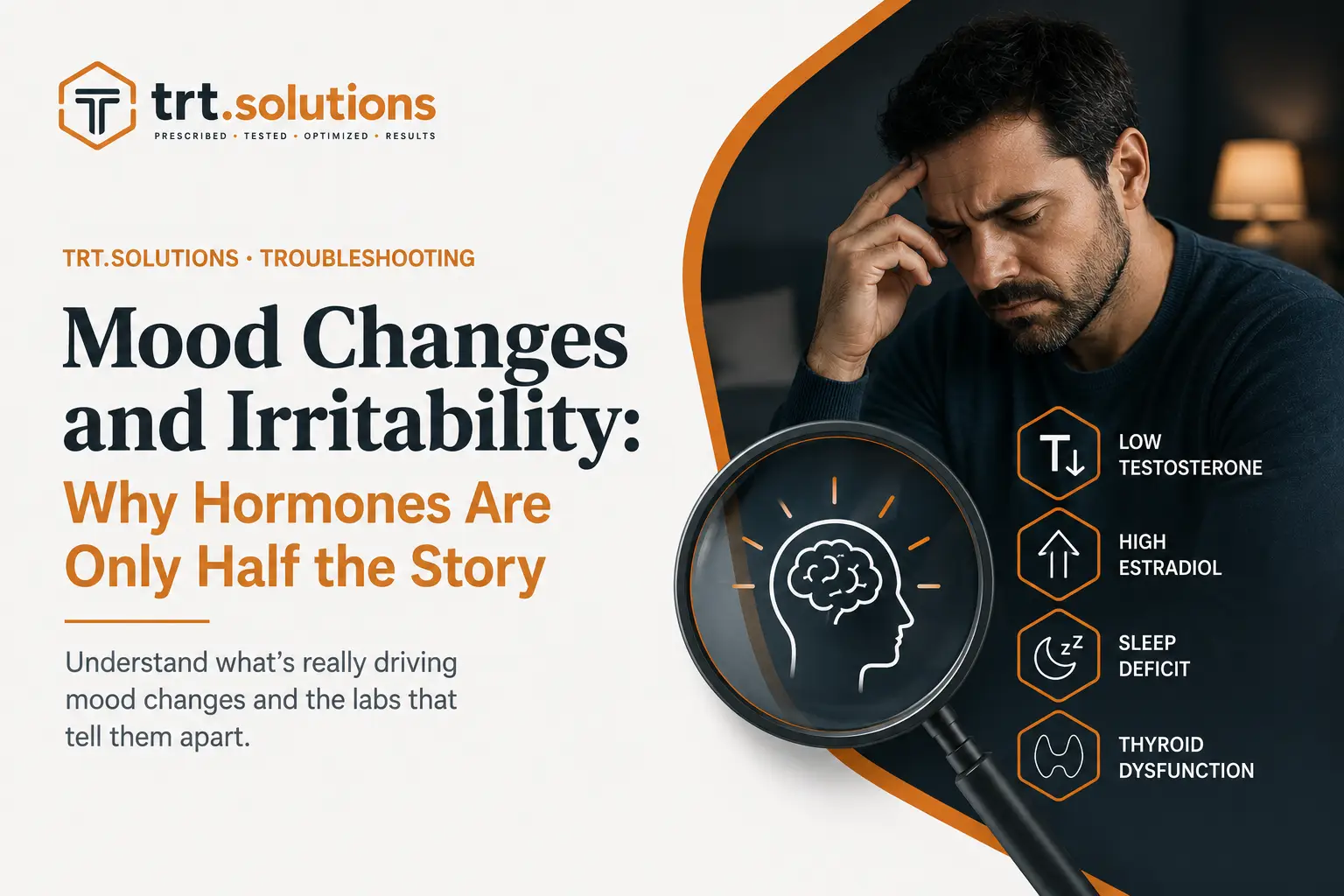
The card that brought you here lists four causes, and each one can shift mood on its own. In practice they interact, which is why the honest answer is usually more than one thing.
- Low testosterone. Genuine deficiency is associated with dysphoria, irritability, low drive, and depressed mood in a subset of men. Depressive symptoms have been reported in a large share of hypogonadal men, though low testosterone does not automatically cause clinical depression.
- High estradiol. Testosterone converts to estradiol, and when estradiol runs high the balance can affect mood and emotional volatility. Estrogen influences the same mood-regulating pathways in men that it does in women, so the level matters in both directions.
- Sleep deficit. Poor sleep is one of the fastest ways to wreck mood. Even a single night of sleep deprivation reliably increases anxiety, irritability, and low mood, and chronic short sleep compounds it.
- Thyroid dysfunction. The thyroid is a classic mood mimic. An underactive thyroid looks like depression, while an overactive one looks like anxiety and irritability, and both are easy to miss without a blood test.
The takeaway is that mood is a poor witness to its own cause. It tells you something has shifted, not what shifted it, which is the whole reason to look under the hood rather than assume.
Why Both Low and High Hormones Cause Trouble
The most important idea in this whole topic is that hormones and mood do not follow a straight line. With testosterone, low levels are linked to depressed mood in some men, yet elevated levels, especially from overshooting on therapy, are associated with irritability and hypomanic symptoms. More is not automatically better.
Estradiol behaves the same way. Too little can bring on anxiety and irritability, and too much can drive emotional volatility and mood swings. This U-shaped pattern is why the goal is balance rather than maximizing any single number, and why chasing a higher testosterone level to feel better can sometimes backfire into a shorter fuse. The same low-T picture also overlaps with fatigue and low energy and low libido, which is why mood is rarely the only symptom when hormones are truly the driver.
The Sleep Factor People Underrate
Sleep deserves its own section because it is both a powerful mood driver and one that people consistently discount. Research on acute sleep loss shows that even 24 hours without sleep increases anxiety, fatigue, confusion, and depressive feelings, alongside measurable changes in stress hormones.
There is also a loop worth knowing about. Poor sleep worsens mood, and low testosterone and thyroid problems both disturb sleep, so the same night of broken rest can be both a cause of your irritability and a symptom of the hormonal issue underneath it. If your sleep is poor, fixing it can lift mood faster than any hormone adjustment, and it belongs on the list regardless of what the labs show.
The Thyroid Mimic
Thyroid dysfunction is the cause most likely to be mistaken for a primary mood disorder, because the symptoms line up almost perfectly. An underactive thyroid produces fatigue, low motivation, and depressed mood that can look exactly like depression. An overactive thyroid produces anxiety, restlessness, irritability, and insomnia that can look exactly like an anxiety disorder.
The difference is that thyroid problems show up clearly on a blood test, whereas mood disorders are diagnosed by observation. That makes a simple thyroid screen one of the highest-value checks in any mood workup, because it can catch a treatable physical cause before anyone concludes the problem is purely psychological.
The Labs That Settle It
The point of testing is to separate these causes and to catch the ones that masquerade as each other. Hormones are measured carefully, because timing and balance both matter.
- Morning total and free testosterone, repeated. Testosterone peaks early in the day, so it is drawn in the morning and confirmed on a second occasion. Free testosterone shows how much is actually available to tissue.
- Estradiol. Measured alongside testosterone so the balance can be judged. Both high and low estradiol can affect mood, so the number is read in context, not chased in one direction.
- TSH, with free T4 if flagged. Screens for the underactive or overactive thyroid that mimics depression and anxiety respectively. One of the highest-value tests in a mood workup.
- A sleep assessment. Not a blood test, but essential. Poor sleep is a leading mood driver and can be both cause and symptom, so it is evaluated alongside the bloodwork.
- A mood and stress review. Screening for depression, anxiety, and life stress matters as much as the hormones, since a primary mood disorder needs its own treatment and will not resolve by adjusting a hormone.
Reference ranges vary between laboratories, so read each result against your own report, and interpret the panel as a whole rather than fixating on one number.
Why Hormones Alone Rarely Fix Mood
Even when a hormone is genuinely off, treating the number is not the same as treating the mood. Evidence suggests testosterone therapy can improve mild mood symptoms in hypogonadal men, but severe depression does not reliably respond to it, and established treatments such as therapy and psychiatric care remain first line for a genuine mood disorder.
That is the shift this approach is built around. A change in mood is a signal to investigate broadly, confirm carefully, and treat the actual driver, which might be a hormone, might be sleep, might be the thyroid, and might be a mood disorder that deserves its own care rather than a hormonal workaround.
What to Do Right Now
- Track the pattern. Note when your mood shifted and what came with it, poor sleep, a dose change, more stress, or other symptoms like low libido or fatigue. The pattern tells a clinician more than the mood alone.
- Ask for the full panel. Request morning total and free testosterone, estradiol, and TSH together, so both hormone balance and the thyroid are checked rather than testosterone alone.
- Take sleep seriously. Be honest about how you are sleeping, and ask about a sleep assessment. Fixing sleep can lift mood faster than any hormone change.
- Do not chase a higher number. Because both high and low hormones affect mood, resist the urge to push testosterone or estradiol in one direction to feel better. Let the labs guide balance.
- Treat a mood disorder as real. If depression or anxiety is part of the picture, say so plainly. It deserves its own care and will not be fixed by a hormone adjustment alone.
Frequently Asked Questions
Q: Can low testosterone really make me irritable and low?
It can in some men. Genuine testosterone deficiency is associated with dysphoria, irritability, and depressed mood, and depressive symptoms are common in hypogonadal men. But low testosterone does not automatically cause clinical depression, which is why the full picture matters.
Q: I started TRT and feel more irritable, not less. Why?
Mood does not simply improve with more testosterone. Higher levels, especially from overshooting, are linked to irritability and hypomanic symptoms, and rising testosterone can push estradiol up too. This is worth raising with your prescriber rather than adjusting anything yourself.
Q: How does estradiol affect my mood if I’m a man?
Estradiol is active in the male brain and influences the same mood pathways it does in women. Both too much and too little can affect mood, which is why it is measured alongside testosterone and read for balance rather than pushed in one direction.
Q: Could my mood problem just be poor sleep?
Quite possibly. Even short-term sleep loss reliably increases anxiety, irritability, and low mood. Poor sleep can also be a symptom of low testosterone or thyroid trouble, so it is worth assessing on its own regardless of your hormone levels.
Q: Why check my thyroid for a mood problem?
Because thyroid dysfunction mimics mood disorders closely. An underactive thyroid looks like depression and an overactive one looks like anxiety, and both show up clearly on a simple blood test, making a thyroid screen one of the most useful checks in a mood workup.
Related Reading
- Fatigue and Low Energy: When It’s Testosterone, and When It’s Something Else the overlapping low-T symptom, and how sleep and thyroid fit in.
- Low Libido and TRT another symptom where hormones are only part of the story.
- TRT Symptoms the full list of symptoms worth checking.
- Ask Your Prescriber how to turn your labs into the right questions.
References
- Amanollahi A, et al. The effect of testosterone levels on mood in men: a review. PubMed. https://pubmed.ncbi.nlm.nih.gov/24016385/
- The association of hypogonadism with depression and its treatments. Frontiers in Endocrinology. https://www.frontiersin.org/journals/endocrinology/articles/10.3389/fendo.2023.1198437/full
- Zitzmann M. (2020). Testosterone, mood, behaviour and quality of life. Andrology. https://onlinelibrary.wiley.com/doi/10.1111/andr.12867
- The role of estradiol in male reproductive function. PMC. https://pmc.ncbi.nlm.nih.gov/articles/PMC4854098/
- Acute sleep deprivation disrupts emotion, cognition, inflammation, and cortisol in young healthy adults. PMC. https://www.ncbi.nlm.nih.gov/pmc/articles/PMC9538963/
- The Link between Thyroid Function and Depression. PMC. https://pmc.ncbi.nlm.nih.gov/articles/PMC3246784/
- Abnormal brain functional connectivity leads to impaired mood and cognition in hyperthyroidism. PMC. https://www.ncbi.nlm.nih.gov/pmc/articles/PMC5351631/
- American Urological Association. Testosterone Deficiency Guideline. https://www.auanet.org/guidelines-and-quality/guidelines/testosterone-deficiency-guideline
Disclaimer
This article is for informational and educational purposes only. It does not constitute medical advice, and reading it does not create a patient-provider relationship. Individual symptoms and treatment needs vary, so please consult a qualified healthcare professional for personalized guidance, and never start, stop, or change any medication or therapy without your prescriber.
If you are struggling with your mental health or having thoughts of harming yourself, help is available. In the US, you can call or text 988 to reach the Suicide and Crisis Lifeline, available 24/7.