Muscle that gets harder to build or hold onto despite steady training is a genuinely frustrating problem, and a reasonable reason to wonder about testosterone. The link is real. Testosterone is one of the body’s main muscle-building signals, so when it drops, gaining and keeping muscle gets harder. But it is far from the only explanation, and the most common culprits are often not hormonal at all.
This is where a lot of men jump to the wrong conclusion. Testosterone reliably increases muscle protein synthesis and lean mass when a true deficiency is corrected, which is well documented. Yet under-eating, a training program that has stalled, and normal aging can each blunt your results just as much, and they respond to changes you can make without touching a hormone.
This post breaks down what actually drives muscle loss and poor gains, how testosterone fits in, why food and training usually matter more than men expect, and which labs are worth checking. If your strength or size has slipped despite putting in the work, this is for you.
The Four Reasons Muscle Slips
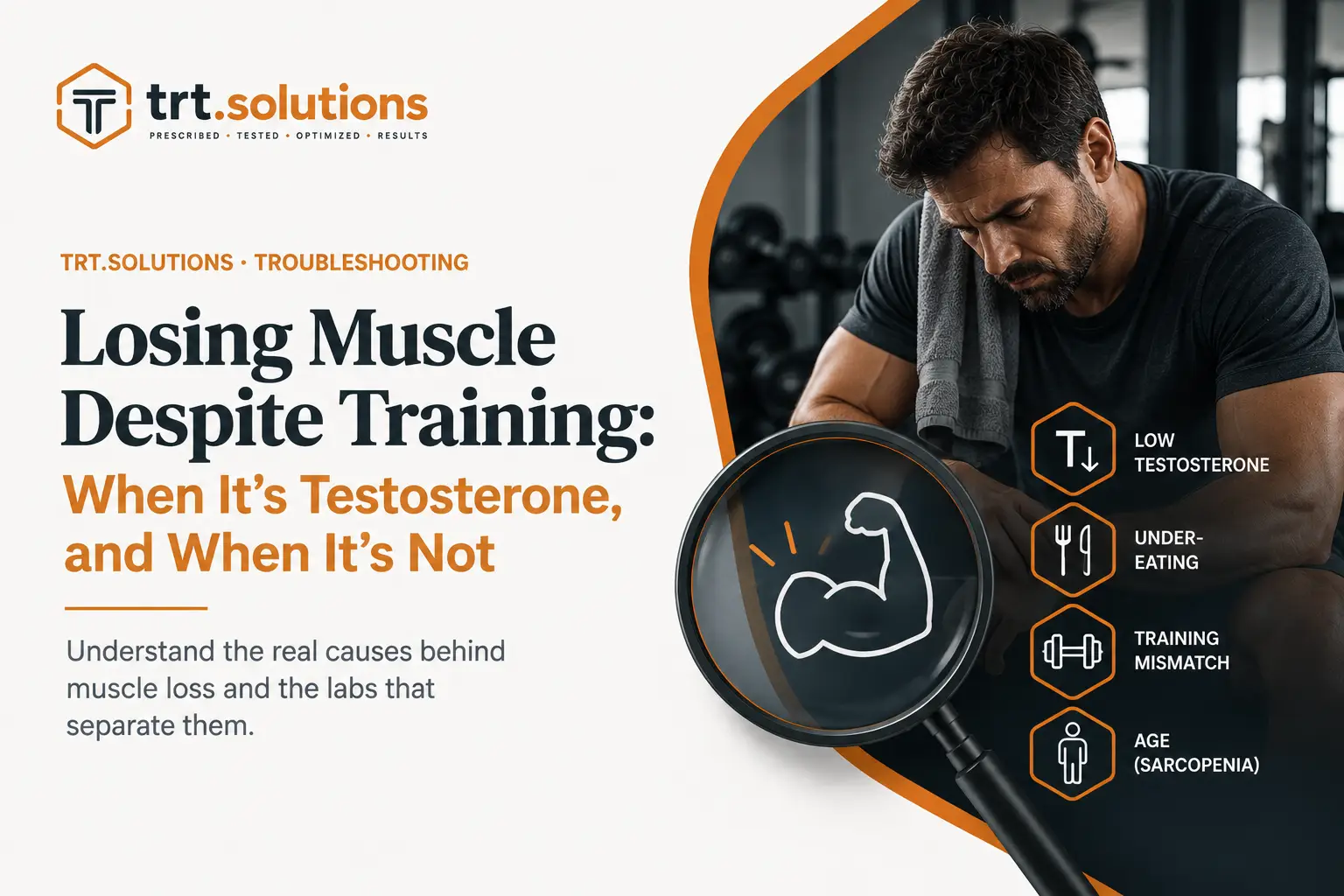
The card that brought you here lists four causes, and each can stall muscle on its own. In real life they stack, which is why a single explanation is usually too simple.
- Low testosterone. A genuine driver. Testosterone stimulates muscle protein synthesis, and when levels are truly low, gaining and maintaining muscle becomes measurably harder. Correcting a real deficiency restores some of that capacity.
- Under-eating. The most overlooked cause. Muscle cannot be built or held in a persistent energy or protein deficit, and eating too little switches the body toward breaking muscle down rather than building it up.
- Training mismatch. A program that no longer challenges you stops producing gains. Without progressive overload, gradually increasing weight, reps, or volume, the muscle has no reason to adapt, no matter how consistent you are.
- Age. Muscle is naturally lost with age, a process called sarcopenia, driven partly by muscle becoming less responsive to protein and training. It is real, but it is slowed dramatically by the right food and training rather than being inevitable.
The takeaway is that difficulty building muscle points in several directions at once. It tells you the muscle-building equation is off somewhere, not that testosterone specifically is the problem.
What Testosterone Actually Does for Muscle
Testosterone earns its reputation here. It is one of the body’s primary anabolic signals, increasing muscle protein synthesis, supporting lean mass, and helping inhibit muscle breakdown. Studies show that restoring testosterone in men with a genuine deficiency raises muscle protein synthesis rates and increases fat-free mass.
The important qualifier is genuine deficiency. The dramatic muscle effects seen with high or supraphysiologic doses come from levels well above the normal range and carry real risks, which is not the same as correcting a true shortfall. Within a normal, healthy range, pushing testosterone higher does not reliably translate into proportionally more muscle, and chasing that can cause other problems. This is the same low-T picture that overlaps with fatigue and low energy, which is why muscle loss rarely shows up as the only symptom when testosterone is truly the cause.
The Food Problem Most Men Miss
Under-eating is the cause most likely to be mistaken for a hormone problem, because the result looks the same, poor gains despite hard training. Muscle is expensive for the body to build, and it will not do it when energy or protein is chronically short.
Two numbers matter here. Total calories have to at least support your activity, because a persistent deficit shifts the body toward breaking down muscle for fuel. And protein has to be adequate, with expert groups suggesting older and active adults often need meaningfully more than the basic recommendation, in the region of 1.0 to 1.5 grams per kilogram of body weight per day depending on the person. Get these wrong and no amount of training, or testosterone, will fully compensate.
When the Training Is the Problem
Consistency is not the same as effective training. A program that stays the same becomes easier over time, and easy training stops driving adaptation. The principle that builds muscle at any age is progressive overload, gradually increasing the demand by adding weight, reps, or sets as you get stronger.
This is also the single most powerful lever against age-related muscle loss. Progressive resistance training is repeatedly shown to build strength and muscle even in much older adults, which is why experts describe it as the best tool for preserving muscle regardless of age. If your routine has not changed in months, the training, not your hormones, may be what has stalled.
The Labs That Settle It
The point of testing is to check whether a hormone is genuinely involved before assuming it is, and to catch other contributors. Testosterone in particular is measured carefully, because timing changes the result.
- Morning total and free testosterone, repeated. Testosterone peaks early in the day, so it is drawn in the morning and confirmed on a second occasion. Free testosterone shows how much is actually available to muscle tissue.
- SHBG. Sex hormone-binding globulin controls how much testosterone is free versus bound, so a high level can leave you symptomatic even when total testosterone looks normal.
- Thyroid (TSH). Thyroid problems affect metabolism, energy, and body composition, and can quietly undermine training results.
- A nutrition and training review. Not a blood test, but the highest-yield check of all. An honest look at calorie intake, daily protein, and whether the program actually progresses often explains more than any lab value.
Reference ranges vary between laboratories, so read each result against your own report, and interpret the panel as a whole rather than fixating on one number.
Why Testosterone Alone Rarely Fixes It
Even when testosterone is genuinely low, it is only one input into a larger equation. Muscle is built by the combination of adequate calories, enough protein, progressive training, and recovery, with hormones setting the ceiling rather than doing the work. Correcting a real deficiency can help, but it will not overcome chronic under-eating or a stalled program.
That is the shift this approach is built around. Difficulty building muscle is a signal to check the whole system, food, training, recovery, and hormones, and to fix the part that is actually broken rather than assuming it must be testosterone.
What to Do Right Now
- Audit your food first. Track your calories and protein honestly for a week. Under-eating is the most common hidden cause, and it is the fastest thing to fix.
- Check whether your training actually progresses. If the weights, reps, or sets have not increased in months, add progressive overload before blaming your hormones.
- Ask for the right labs. Request morning total and free testosterone, SHBG, and TSH together, so a genuine hormone issue is confirmed rather than assumed.
- Prioritize recovery. Muscle is built during rest. Poor sleep and constant overtraining undercut gains no matter how good your program or hormones are.
- Do not start therapy to fix training. Do not reach for testosterone to compensate for food, program, or recovery gaps. Fix those first and let the labs decide if a hormone is truly involved.
Frequently Asked Questions
Q: Does low testosterone cause muscle loss?
It can. Testosterone stimulates muscle protein synthesis, so a genuine deficiency makes building and keeping muscle harder, and correcting a real shortfall helps. But under-eating, stalled training, and aging cause the same result, which is why the full picture matters.
Q: Will higher testosterone build more muscle?
Only up to a point. Correcting a true deficiency helps, but within a normal healthy range, pushing testosterone higher does not reliably produce proportionally more muscle. The dramatic effects seen with very high doses come with real risks and are not the same as treating a shortfall.
Q: How much protein do I actually need to keep muscle?
More than many men think. Expert groups suggest active and older adults often benefit from around 1.0 to 1.5 grams of protein per kilogram of body weight per day, depending on the person. Chronic under-eating of protein blunts gains regardless of training or hormones.
Q: Can I still build muscle as I get older?
Yes. Age-related muscle loss is real, but progressive resistance training combined with adequate protein builds strength and muscle even in much older adults. Aging slows the process, it does not stop it, and the right training and nutrition make a large difference.
Q: My testosterone is normal but I’m still not gaining. Why?
Then the cause is more likely food, training, or recovery than hormones. Normal labs point the workup toward calorie and protein intake, whether your program actually progresses, and how well you are sleeping and recovering, all of which are fixable.
Related Reading
- Fatigue and Low Energy: When It’s Testosterone, and When It’s Something Else another symptom that overlaps with low T but often has other causes.
- Low Libido and TRT part of the same low-T symptom cluster.
- TRT Symptoms the full list of symptoms worth checking.
- Ask Your Prescriber how to turn your labs into the right questions.
References
- Bhasin S, et al. (2026). Mechanisms of Testosterone’s Anabolic Effects on Muscle and Function. Endocrine Reviews. https://academic.oup.com/edrv/article-abstract/47/2/280/8373600
- Brodsky IG, et al. Effects of testosterone replacement on muscle mass and muscle protein synthesis in hypogonadal men. PubMed. https://pubmed.ncbi.nlm.nih.gov/8855787/
- Bhasin S, et al. The Effects of Supraphysiologic Doses of Testosterone on Muscle Size and Strength in Normal Men. NEJM. https://www.nejm.org/doi/full/10.1056/NEJM199607043350101
- Deutz NEP, et al. Protein intake and exercise for optimal muscle function with aging: ESPEN Expert Group recommendations. Clinical Nutrition. https://www.clinicalnutritionjournal.com/article/S0261-5614(14)00111-3/fulltext
- Harvard Health. Preserve your muscle mass. https://www.health.harvard.edu/staying-healthy/preserve-your-muscle-mass
- Cleveland Clinic. Sarcopenia (Muscle Loss): Symptoms and Causes. https://my.clevelandclinic.org/health/diseases/23167-sarcopenia
- Strength Training and Nutrition Help Prevent Sarcopenia in Older Adults. PMC. https://www.ncbi.nlm.nih.gov/pmc/articles/PMC12295157/
- American Urological Association. Testosterone Deficiency Guideline. https://www.auanet.org/guidelines-and-quality/guidelines/testosterone-deficiency-guideline
Disclaimer
This article is for informational and educational purposes only. It does not constitute medical advice, and reading it does not create a patient-provider relationship. Individual symptoms and treatment needs vary, so please consult a qualified healthcare professional for personalized guidance, and never start, stop, or change any medication or therapy without your prescriber.