Fat that creeps on around the middle despite no obvious change in habits is a common reason men start asking about testosterone. The instinct makes sense, low testosterone and weight gain do travel together. But the relationship is not a simple one-way street, and understanding which way it runs changes what you should actually do about it.
Here is the twist that most articles skip. Research describes the link between obesity and low testosterone as bidirectional, meaning excess fat lowers testosterone and low testosterone encourages more fat, each feeding the other. In fact, one large analysis concluded that low testosterone in many men is better understood as a phenotype of visceral fat biology than a separate hormonal disease.
This post breaks down how fat and testosterone drive each other, where insulin resistance and diet fit in, and why the fix is often the opposite of what men expect. If your weight has climbed and you are wondering whether hormones are the cause or the consequence, this is for you.
The Four Forces Behind Central Weight Gain
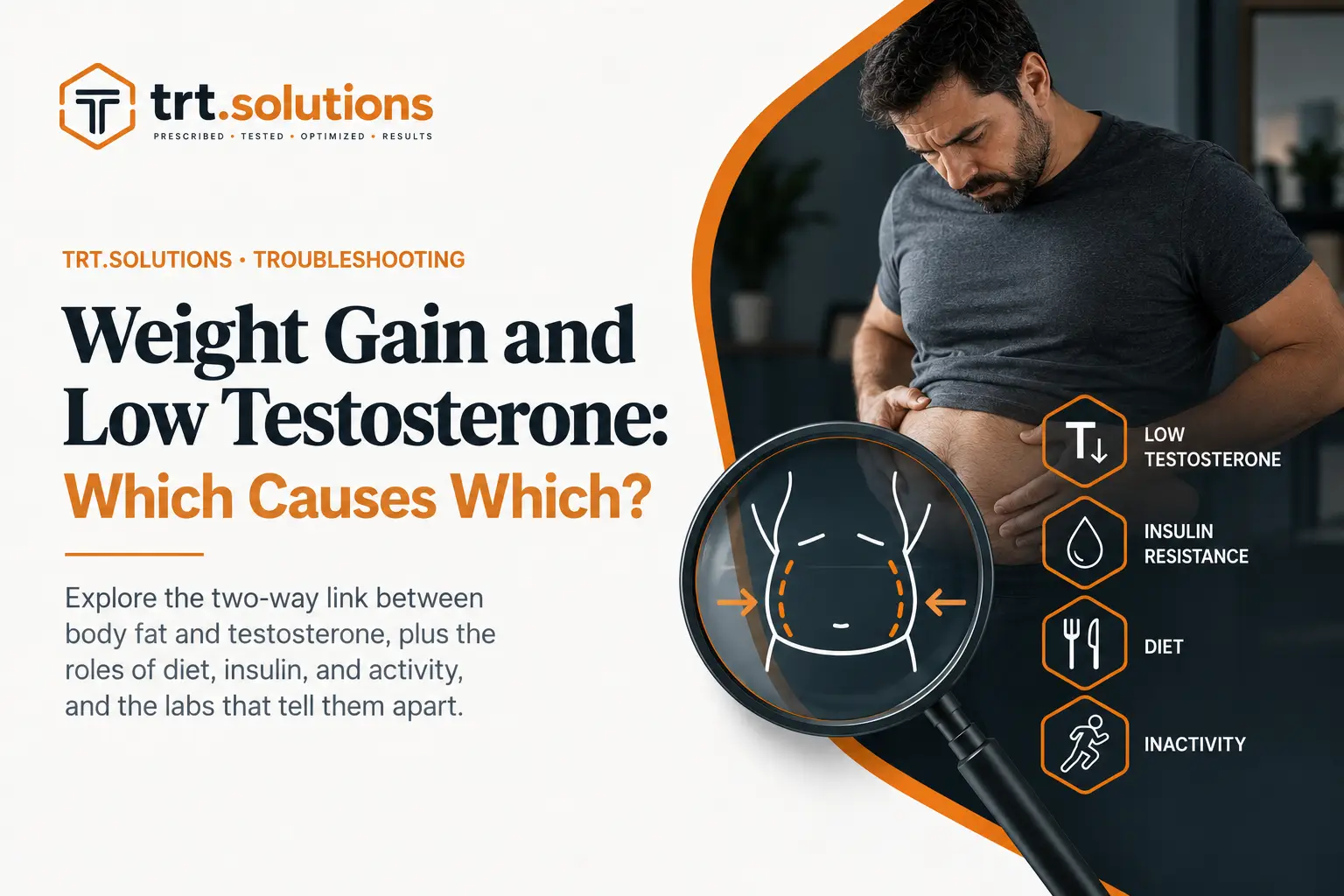
The card that brought you here lists four causes, and they are deeply interconnected. Central fat, in particular, sits at the hub where hormones, insulin, diet, and activity all meet.
- Low testosterone. Testosterone helps regulate fat metabolism and limit fat storage, so genuinely low levels can encourage fat accumulation, especially around the middle. But it is often as much a consequence of excess fat as a cause of it.
- Insulin resistance. Visceral fat drives insulin resistance, and the resulting high insulin lowers SHBG and testosterone while promoting more fat storage. This is the engine at the center of the whole cycle.
- Diet. What and how much you eat sets the calorie balance that determines fat gain, and it also directly influences insulin, inflammation, and hormone levels. It is the most modifiable factor of the four.
- Inactivity. Low physical activity reduces energy expenditure, worsens insulin sensitivity, and is independently linked to lower testosterone, so a sedentary routine feeds the cycle from several directions at once.
The takeaway is that central weight gain is rarely one thing. It is usually a self-reinforcing loop, which is both why it feels stubborn and why the right intervention can unwind several causes at once.
The Vicious Cycle: How Fat and Low Testosterone Feed Each Other
This is the single most important idea in the topic. Excess body fat, especially visceral fat, contains high levels of an enzyme called aromatase, which converts testosterone into estradiol. More fat means more conversion, which lowers testosterone and raises estrogen, and the altered balance signals the body to make even less testosterone.
At the same time, low testosterone makes it easier to gain fat and harder to build the muscle that would burn energy, so the fat gain accelerates. Add insulin resistance, which both results from visceral fat and further suppresses testosterone, and you have a loop that reinforces itself. This is why the same visceral fat also overlaps with the causes behind fatigue and low energy and low libido, since the metabolic disruption rarely shows up as weight alone.
Why Weight Loss Often Fixes the Testosterone
Because the cycle runs in both directions, breaking it at the fat end often raises testosterone on its own. This is one of the best-supported findings in the whole area. Reviews consistently show that losing weight, particularly visceral fat, increases testosterone levels, and that the more fat lost, the larger the rise.
The evidence is striking enough that experts argue overweight men with low testosterone should generally try diet and exercise first, before reaching for hormone therapy. In one large study of men with prediabetes, lifestyle changes alone reduced the share of men with low testosterone, and increased physical activity in particular tracked with the biggest hormonal gains. Chasing the number with a prescription can miss the driver sitting underneath it.
The Role of Diet and Movement
If weight loss is the lever, diet and activity are how you pull it, and each does more than just cut calories.
- Diet quality and quantity. A sustained calorie balance in your favor drives fat loss, while diet patterns such as Mediterranean-style eating have been linked to better testosterone and metabolic markers in men with obesity.
- Physical activity. Movement improves insulin sensitivity and burns energy, and studies suggest increasing activity may raise testosterone even more than calorie restriction alone during weight loss.
- Resistance training. Building or preserving muscle raises resting energy use and improves how the body handles glucose, attacking insulin resistance directly.
- A note on the dynamic phase. Testosterone can dip temporarily during active, aggressive dieting, so it is best measured once weight has stabilized rather than in the middle of rapid loss.
The Labs That Settle It
The point of testing is to see where you are in the cycle, and to catch the metabolic problems that travel with central fat. Hormones are measured carefully, because timing and body fat both affect the numbers.
- Morning total and free testosterone, repeated. Drawn in the morning and confirmed on a second occasion. In men carrying more fat, SHBG is often low, so free testosterone gives a clearer picture than total alone.
- SHBG. Frequently lowered by the high insulin that comes with visceral fat, which is why total testosterone can look low even when the underlying picture is metabolic.
- Estradiol. Often elevated when body fat is high, because fat tissue converts testosterone to estradiol. Measuring it shows how far the balance has shifted.
- Fasting glucose, HbA1c, and fasting insulin. These reveal the insulin resistance sitting at the center of the cycle, and often matter more for your health than the testosterone number itself.
- A lipid panel and waist measurement. Central fat and metabolic risk travel together, so waist circumference and lipids round out the picture a single hormone cannot give.
Reference ranges vary between laboratories, so read each result against your own report, and interpret the panel as a whole rather than fixating on one number.
Why Testosterone Alone Is Rarely the Answer
Even when testosterone is genuinely low, treating the hormone in isolation often misses the point when excess fat is driving it. The insulin resistance, inflammation, and metabolic risk that accompany central fat do not resolve just because a testosterone number goes up, and the underlying fat can keep pulling the hormone back down.
That is the shift this approach is built around. Central weight gain is a signal to look at the whole metabolic picture, fat, insulin, diet, and activity, and to break the cycle at the point that improves the most at once, which for many men is the weight itself rather than the hormone.
What to Do Right Now
- Measure your waist, not just your weight. Central fat is the metabolically active kind. Tracking waist circumference tells you more about the cycle than the scale alone.
- Target visceral fat first. Because fat and low testosterone feed each other, losing central fat can raise testosterone naturally, often before any therapy is needed.
- Ask for the metabolic panel, not just testosterone. Request morning total and free testosterone, SHBG, estradiol, plus fasting glucose, HbA1c, and insulin, so the insulin resistance underneath is visible.
- Move more, and add resistance training. Increasing activity may raise testosterone even more than dieting alone, and building muscle attacks insulin resistance directly.
- Do not test testosterone mid-diet. Levels can dip during aggressive weight loss, so wait until your weight has stabilized before drawing conclusions, and let your prescriber guide the plan.
Frequently Asked Questions
Q: Does low testosterone cause weight gain, or does weight gain cause low testosterone?
Both, and that is the key point. The relationship is bidirectional, so excess fat lowers testosterone and low testosterone encourages more fat. For many men, the excess fat is the primary driver, which is why addressing weight often improves the hormone.
Q: Will testosterone therapy help me lose belly fat?
It can modestly affect body composition in men with genuine deficiency, but it is not a weight-loss treatment, and it does not fix the insulin resistance and diet issues driving central fat. Experts generally recommend trying weight loss first in overweight men with low testosterone.
Q: Can losing weight actually raise my testosterone?
Yes, and the evidence is strong. Losing weight, especially visceral fat, reliably increases testosterone levels, and the more fat lost, the bigger the rise. This is why lifestyle change is usually the recommended first step.
Q: Why is belly fat specifically linked to low testosterone?
Visceral fat is metabolically active. It drives insulin resistance, lowers SHBG, and contains high levels of aromatase, the enzyme that converts testosterone into estradiol. Together these push testosterone down, which is why central fat matters more than overall weight.
Q: Should I get my testosterone checked while actively dieting?
It is better to wait. Testosterone can temporarily dip during aggressive calorie restriction and only stabilizes once weight loss plateaus, so testing mid-diet can give a misleadingly low result. Measure once your weight has settled.
Related Reading
- Fatigue and Low Energy: When It’s Testosterone, and When It’s Something Else another symptom driven by the same metabolic picture.
- Low Libido and TRT part of the same cluster that travels with central fat.
- TRT Symptoms the full list of symptoms worth checking.
- Ask Your Prescriber how to turn your labs into the right questions.
References
- Kelly DM, Jones TH. The Significance of Low Testosterone Levels in Obese Men. Current Obesity Reports. https://link.springer.com/article/10.1007/s13679-012-0029-4
- Low testosterone is a phenotype of visceral adiposity. Journal of the Endocrine Society (PMC). https://pmc.ncbi.nlm.nih.gov/articles/PMC13386011/
- Altered Expression of Aromatase and Estrogen Receptors in Adipose Tissue From Men With Obesity or Type 2 Diabetes. JCEM (PMC). https://www.ncbi.nlm.nih.gov/pmc/articles/PMC12448628/
- Impact of Weight Loss on Testosterone Levels: A Review of BMI and Testosterone. Cureus (PMC). https://www.ncbi.nlm.nih.gov/pmc/articles/PMC11745839/
- The Role of Diet and Weight Loss in Improving Secondary Hypogonadism in Men with Obesity. PMC. https://www.ncbi.nlm.nih.gov/pmc/articles/PMC6950423/
- Approach to the Patient: Low Testosterone Concentrations in Men With Obesity. JCEM. https://academic.oup.com/jcem/article/110/9/e3125/8058933
- Physical activity and testosterone during lifestyle modification in overweight and obese men. PMC. https://pmc.ncbi.nlm.nih.gov/articles/PMC4706091
- American Urological Association. Testosterone Deficiency Guideline. https://www.auanet.org/guidelines-and-quality/guidelines/testosterone-deficiency-guideline
Disclaimer
This article is for informational and educational purposes only. It does not constitute medical advice, and reading it does not create a patient-provider relationship. Individual symptoms and treatment needs vary, so please consult a qualified healthcare professional for personalized guidance, and never start, stop, or change any medication or therapy without your prescriber.